
Pṛthivī (पृथ्वी) – Earth

 
“Due to the interaction of water with the taste perception, the subtle element odor evolves under superior Thence the earth and the olfactory sense, by which we can variously experience the aroma of the earth”
 
(Śrīmad Bhāgavatam 3.26.44)


The earth element is the last element to be discussed here.
 
It is characterized by solidity, density, and firmness. Known as Prithivi, it forms the stable foundation that supports life on this planet. It nurtures and sustains all living beings, providing both nourishment and protection. Everything that is structurally solid or compact—such as bones, cartilage, nails, hair, teeth, and skin—arises from the earth element.
 
In addition, Earth is linked to mechanical energy, reflecting its association with structure, support, and physical force.
 
 
Attributes of Earth
 
  • Gunas (Qualities): Heavy, dull, static, dense, hard, gross. The Gunas describe the basic characteristics of an element.
  • Karmas (Actions/Principles): Karmas are the fundamental modes of action or movement patterns of the element. For earth it is gravitation, downward attraction.
  • Jñānendriya (Sensory Faculty): Jñānendriya denotes the sense organ through which we perceive the world. For the Earth element, this is the Smell. Sensory organs are therefore the nose.
  • Karmendriya (Faculty of Action): The Karmendriya is the organ through which we actively act. For Earth, this is Excretion and the motor of organ is the excretory organs.
  • Tanmātra (Subtle Essence): Tanmātra denotes the subtle essence from which sensory perception arises. For Earth, this is sound, touch, form, taste and especially odor (or smell).


The Earth contains all Tanmātras
 
“As clearly explained throughout Śrīmad-Bhāgavatam, the first element, sky, possesses the unique quality of sound. As creation expands, the second element, air, comes into being, and it possesses sound and touch. The third element, fire, possesses sound, touch and form, and the fourth element, water, possesses sound, touch, form and flavor. The earth possesses sound, touch, form, flavor and aroma. As each element loses its unique distinguishing quality, it naturally becomes indistinguishable from the more subtle elements and is thus effectively dissolved as a unique entity.”
Purport of Śrīmad Bhāgavatam 12.4.14


Why does the Earth element encompass all the essences which are experienced by all the senses and what does this mean for us?

In Vedic philosophy, the Śrīmad-Bhāgavatam describes the five elements as a progressive framework of perception.

The first element, Ether (Sky), carries only the experience of sound. With Air comes the sense of touch, with Fire the perception of form, and with Water, taste is added. Only the Earth element unites all five senses – sound, touch, form, taste, and smell.
 
Why is this significant? Earth is the densest and most stable element. It integrates the subtler qualities of the other elements, making them tangible and experientially accessible. Everything we see, feel, smell, or taste is rooted in Earth. In this way, Earth becomes the medium through which thoughts, emotions, and subtle energies take form and manifest.
 
For us, this means that being grounded allows us to perceive the world through all our senses and be fully present. Earth provides stability, structure, and the ability to integrate sensory input and inner experiences. It is therefore not only a material element but also a key to consciousness, perception, and embodied manifestation.


The Earth contains all the other Elements
 
 
The earth element stands apart from the previously described elements. Why is that? The earth element is, in a sense, a term that describes the interplay of all elements, forming a kind of quintessence in the manifested world—but also in the subtler realm of emotions, feelings, and psychological actions or states.
 
 
Prithivi can be understood as the culminating principle within the spectrum of the elements. While it is often said that all other elements are contained within Earth, this statement is best interpreted in a nuanced way. Earth does not literally encompass the other elements as independent forces; rather, it represents the stage at which their interactions become stabilized, tangible, and enduring.
 
In this sense, Earth is not the generator of elemental interplay but the field in which that interplay becomes manifest. The dynamic qualities of Fire, the mobility of Air, and the cohesion of Water all contribute to processes that only achieve lasting form through Earth. What is fluid, transformative, or volatile in other elements finds structure, persistence, and visibility in the earth principle.
 
The Earth Element can be seen as the crystallization of elemental activity- the point at which invisible processes take on concrete expression. Its apparent “containment” of the other elements is therefore not a matter of composition, but of realization. It embodies the results of their interaction, giving them form, continuity, and perceptibility within the material world.
 
For this reason, Earth is the most integrative in terms of outcome. It anchors and consolidates what the other elements initiate, making it the essential basis for manifestation and experience.
 
Earth is not just “matter” in the physical sense, but also the bearer of order, stability, and structure.
 
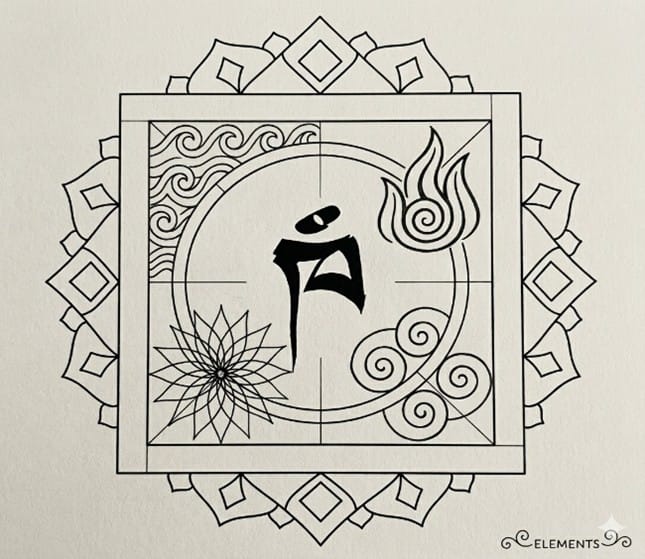
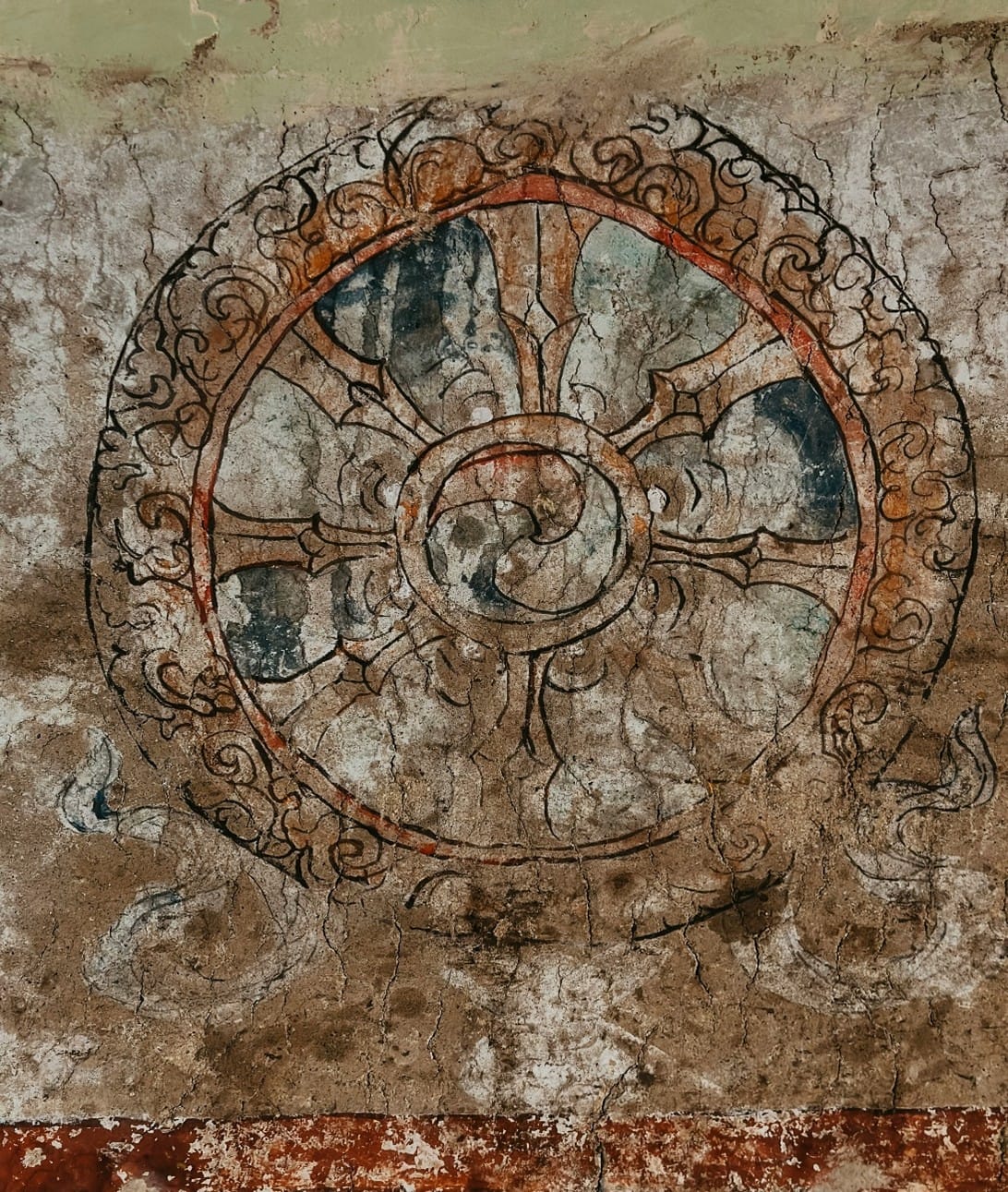
In Tibetan Bön tradition, a shamanic worldview within Tibetan buddhism, the Earth Element is usually the center of everything and is placed in the center of the mandala in graphic representations and in experience.


The ability to manifest
 
What does “manifestation” mean exactly, etymologically? The word “manifestation” comes from the Latin manifestare, meaning “to make evident, to bring to light, to make visible.” It is often broken down into manus (“hand”) and a root related to something firm or tangible, suggesting the idea of “making something graspable by hand.”
 
In its original sense, manifestation means making something that was previously invisible, internal, or only potential into something visible, concrete, and perceptible—essentially bringing something from the inner world into the outer world.
 
In a broader philosophical and spiritual sense, it describes the process by which thought becomes form, idea becomes reality, and potential becomes actuality.
 
This aligns with the concept of the earth element, which can be understood as the medium through which things take shape, become embodied, and gain stability in the material world.
 
To manifest something and transfer it into the world of the visible, the tangible, the perceivable—making it sensually experienceable. Yes, the earth element is so much connected to sensory experience. These are things we can see, smell, taste, touch, and physically perceive.
 
But the Earth element is not only about creations that can be experienced through the senses. It is the capacity for action that embodies structure, order, stability, and groundedness.


Mercury and the Signs
 
As Earth brings things into manifestation it is the reason Mercury is the graha that enables anything to take on a concrete form. Consequently, Mercury holds great significance in all matters. Earth provides the firmness that allows things to rest upon one another and the structural stability needed for one thing to support another. In this sense, Mercury is associated with all forms of foundation.
 
Mercury also governs containers and anything designed to hold something else—such as a constructed form intended to contain water, like a pool. Earth introduces differentiation within the Real: a quality that is inherently good becomes expressed in varying degrees, appearing more pronounced in one context and less in another. Because it is Earth that creates this differentiation, it is Mercury that has the capacity to perceive the single underlying Reality behind all apparent distinctions.
 
Mercury finds its primary expression through the signs Gemini and Virgo. In Gemini, Mercury manifests as movement, exchange, and the dynamic interplay of ideas. Here, its nature is exploratory, communicative, and oriented toward gathering and connecting information. In Virgo, however, Mercury reaches a more refined and grounded expression. It becomes analytical, discriminating, and concerned with precision, order, and practical application. This reflects Mercury’s deeper function: not only to perceive distinctions, but to organize and integrate them into meaningful structure. Virgo, as an earth sign, anchors Mercury’s otherwise fluid and changeable nature, allowing insight to become embodied and useful.
 
The earth signs of the zodiac—Taurus, Virgo, and Capricorn—each represent different dimensions of the material principle. Taurus embodies the sustaining and nourishing aspect of Earth. It is concerned with stability, value, and the enjoyment of the tangible world, giving form a sense of continuity and richness. Virgo, as mentioned, represents the discriminating and refining aspect of Earth. It seeks to perfect, to organize, and to bring clarity and functionality into what already exists. Capricorn, finally, expresses the structuring and enduring aspect of Earth. It is oriented toward form in its most solidified sense—toward systems, responsibility, and the long-term realization of structure and order.


The balanced Earth Element
 

„Walk as if you are kissing the earth with your feet.“

Thich Nhat Hanh


In his book “Healing with form, energy and light” Tenzin Wangyal Rinpoche states that a balanced earth element make us feel stable, grounded and confident. We are neither too heavy nor too airy. We are rooted in our experience, not easily knocked off balance nor do we lose touch with what is important. Faith is steady and the intentions do not easily get sweptaside by impulse and our efforts are consistent. The higher dimension is to be grounded in pure being.

“…people who are predominantly fire and air will quickly have spiritual experiences but they will also quickly lose them. People who are predominantly Earth and Water may be slower to have the experiences but, when they do, they are able to sustain and develop them and ultimately will develop faster.” Tenzin Wangyal in “Healing with Form Energy and Light”.

 
Taking this important statement into account, we can all do something for our elemental balance. Vedic astrology for example is a great help in identifying imbalances among the elements and providing guidance toward achieving greater balance.
 
Too much earth can lead to rigidity, to things becoming hardened. Earth should be permeable. What we need for that, is the water element. This is reflected in the opposing signs in the zodiac. Each earth element is paired with an opposing water element. This is not by chance. So if there is a focus on earth and too little water- we can be dull, lazy and dim, too solid. Unable to move. The thinking is heavy and we are lacking creativity. We can feel depressed, being stuck or resigned in our careers, relationships or spiritual practices.
 
Too much water- too much emotion, too much boundlessness- needs a channel, a structure, a path created from earth, so that this energy can flow, become effective, and remain in harmony. It is needed to move something. To manifest the watery qualities into something substantial.
 
In this process, something as simple as engaging with the earth and with nature can be healing. No matter the activity—anything done with the hands or with the feet, the contact points through which we connect with the ground we walk on daily, the places we move through, the things we hold in our hands, shape, and use to create new things- these are all part of it.
 

A simple and effective exercise to become more grounded, for example, when we have many mental discourses or racing thoughts that create inner restlessness, or when we feel literally flooded by various emotions—is to focus on the contact between our feet and the ground. Ideally, we are in a natural environment, but it can be done anywhere.

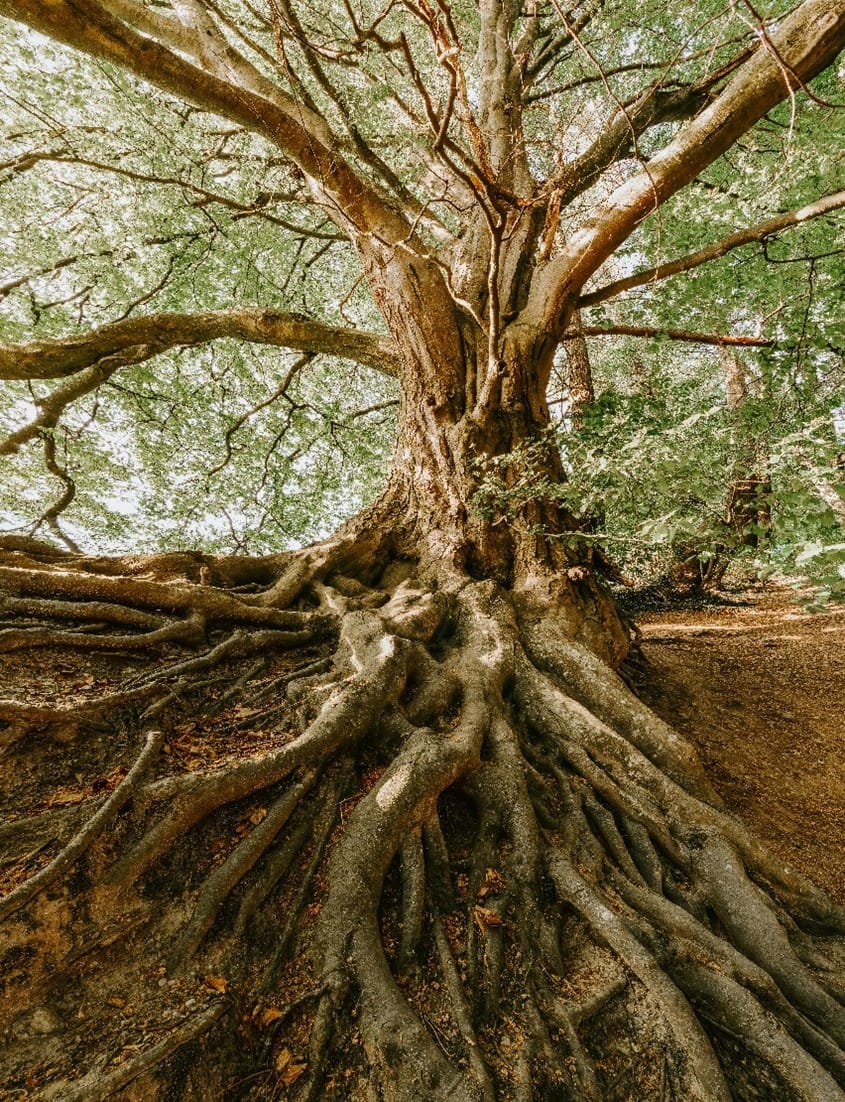
We can also imagine being rooted in the earth like a strong tree (Humans and trees are connected through a shared biological heritage, reflected in some common genes – interesting isn´t it?).


Being more in the earth element also means experiencing the present moment more fully through our senses.
 
I personnally feel a profound connection to the earth element, a deep sense of sensory satisfaction that arises in moments such as kneading dough with my hands. The experience is difficult to put into words—quiet, grounding, and deeply fulfilling, out of nowhere! It draws me entirely into the present moment, as if the act itself dissolves all distraction and brings me back to a state of calm awareness.
 
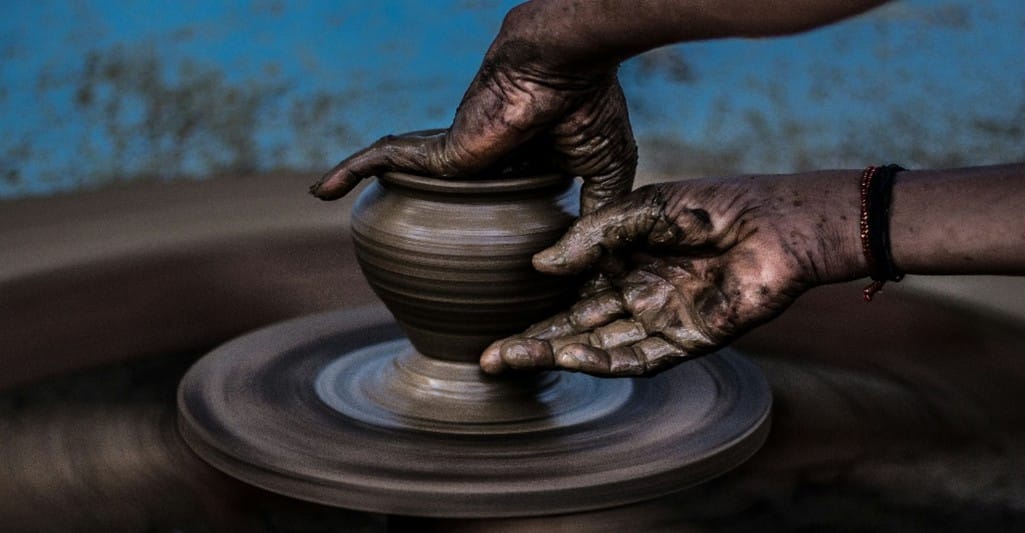
In a similar way, when I hold a lump of clay and begin to shape it, I experience a sense of contact that feels both simple and profound. There is something inherently grounding in touching, pressing, and forming material with one’s hands—something that seems to anchor both body and mind in the here and now.


Matter as Expression of the Invisible
 
Matter can be understood not only as physical thing, but also as a symbolic expression of deeper, non-material realities. Throughout human history, many philosophical and spiritual traditions have viewed the material world as a manifestation of underlying principles, ideas, or consciousness.
 
In this sense, physical reality is not separate from the spiritual or mental realm, but rather its visible and tangible expression. Objects, structures, and natural forms can be seen as symbols—carriers of meaning that point beyond themselves to something deeper. Just as we can use concrete water or earth as a metaphor or image for the full range of subtler expressions of the respective element. Or as in pantheism, the idea that all things, all manifestations, all creations in nature are imbued with spirit.
 
Thus, the act of manifestation is not only about bringing something into physical form, but also about giving shape and expression to what exists on a subtler, more abstract level. The earth, as the element of form and materialization, becomes the medium through which the invisible becomes visible and the abstract becomes concrete. This does not, in turn, mean that everything is a symbol ;)…


Science, Microcosm, and the Nature of Matter
 
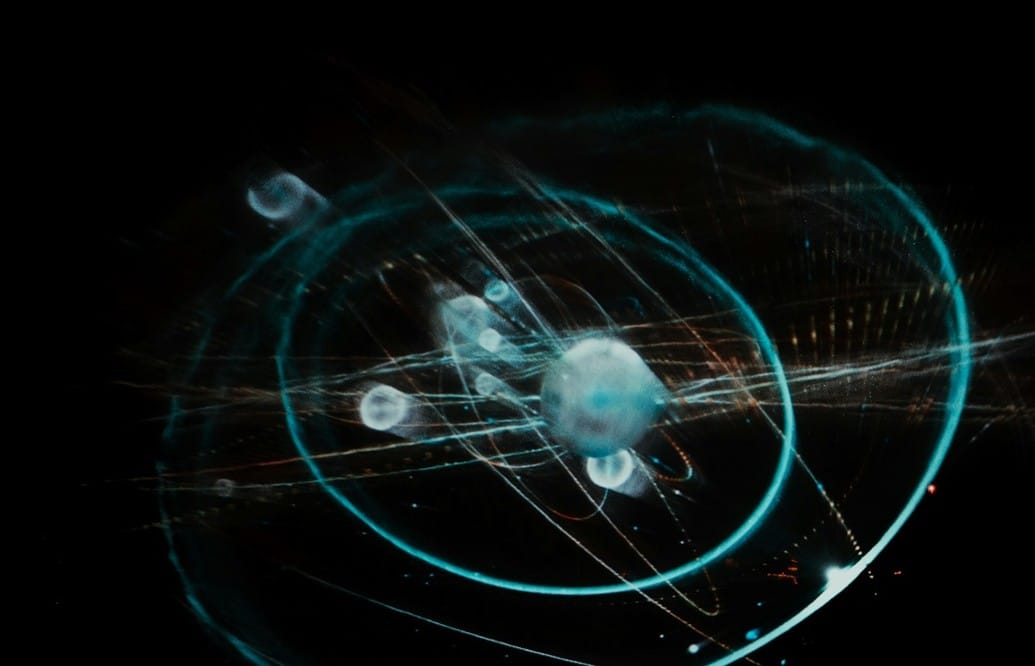
With the development of modern technology, humanity has gained the ability to explore matter at increasingly smaller scales, from molecules to atoms and even subatomic particles. As we go deeper into the structure of matter, it becomes apparent that what we perceive as solid is, in fact, largely composed of space, energy, and dynamic interactions.
 
At these levels, matter no longer behaves like solid, fixed substance in the classical sense. Instead, it reveals itself as a system of probabilities, fields, and relationships. This has led to a shift in how we understand reality—not as something rigid and static, but as something fluid, interconnected, and constantly in flux.
 
While this scientific perspective does not necessarily imply a transcendental or spiritual dimension in a literal sense, it does challenge our everyday assumptions about the nature of reality. For some, this opens the door to philosophical or metaphysical interpretations, where the physical world is seen as a surface expression of deeper, more fundamental principles.
 
Thus, modern exploration of matter can be understood as a process that dissolves the illusion of solidity and invites reflection on the nature of existence itself—whether viewed purely scientifically or through a broader, philosophical lens.


“The idea that an electron exposed to a beam chooses of its own free will the moment and the direction in which it will jump is unbearable to me. If anything, I would rather be a cobbler or even an employee in a casino than a physicist.”
 
Albert Einstein


A Further Paradox
 

„Earth, water, fire, air, ether, mind, intellect and ego—these constitute My separated material energy. “

Krishna/ Quelle: Bhagavad Gita, Kapitel 7, Vers 4

 
In the Bhagavad Gita (7:4), the material world is described as “separated” because it consists of distinct elements—earth, water, fire, air, ether, mind, intellect, and ego. This separation is what allows form, differentiation, and experience to exist at all.
 
Matter, in this sense, only exists through distinction. Thus, material reality depends on limitation and division to become perceivable.
 
However, this separation is not absolute. It is a functional appearance within a deeper unity. The many forms we see arise from one underlying source of energy, and the sense of separateness is what makes manifestation possible in the first place. Separation itself arises within a deeper, unified reality.
 
It is too one-sided to focus solely on the measurable manifestations of life and the world and to think that we can be satisfied with that alone. We must also learn to recognize the symbolic dimension of this world—the spiritual principles, the invisible forces underlying all life.


„Before enlightenment, chop wood, carry water. After enlightenment, chop wood, carry water. “

Saying from Zen Buddhism
 
At the same time, it is of no use to dissolve entirely into these invisible principles. We are human beings with a manifested, material body. Inevitably, we must live within the material realm in the best possible way.
 
As is sometimes common in New Age circles, condemning the material and living only in spiritual spheres is, in my view, deeply unwholesome and not holistic. We must engage with what is sensorially perceptible. Not only that—we can discover within it a profoundly fulfilling dimension, an inner joy, and we can perceive the spiritual dimension within the material itself.
 
Moreover, it is our destiny, as beings in a material body, to experience this world in all its dimensions, to draw our conclusions from it, and to follow our dharma—our life path—in order ultimately to understand and live what defines us as human beings in a multidimensional way.
 
 
So, before I completely lose touch with the ground, I return to a safer place: my garden bed. Just digging my hands into the soil and experiencing it with all my senses, I can discover the incredible life within it—the scents, the textures, and the wonder of a seed I planted weeks ago that has now grown into a thriving plant. All the elemental principles are present in nature and its processes. If we are missing an element in ourselves, we can find it there and nourish ourselves with it. Just by observation and connection.
 
 
Sources:
Lad, Vasant. Textbook of Ayurveda. Fundamental Principles. 2002. The Ayurvedic Press.
Wilhelm, Ernst. Graha Sutras. 2016. Create Space Independent Publishing Platform.
Śrīmad-Bhāgavatam. Bhaktivedanta Vedabase. https://vedabase.io/en/library/sb/. March 2026.
Wangyal, Tenzin. Healing with Form, Energy and Light.2002.SnowLion Boulder
 
Pictures: Unsplash

Leave A Comment

Your email address will not be published. Required fields are marked *